
Battery Energy Storage Systems: A Process-Safety View of BESS Hazards
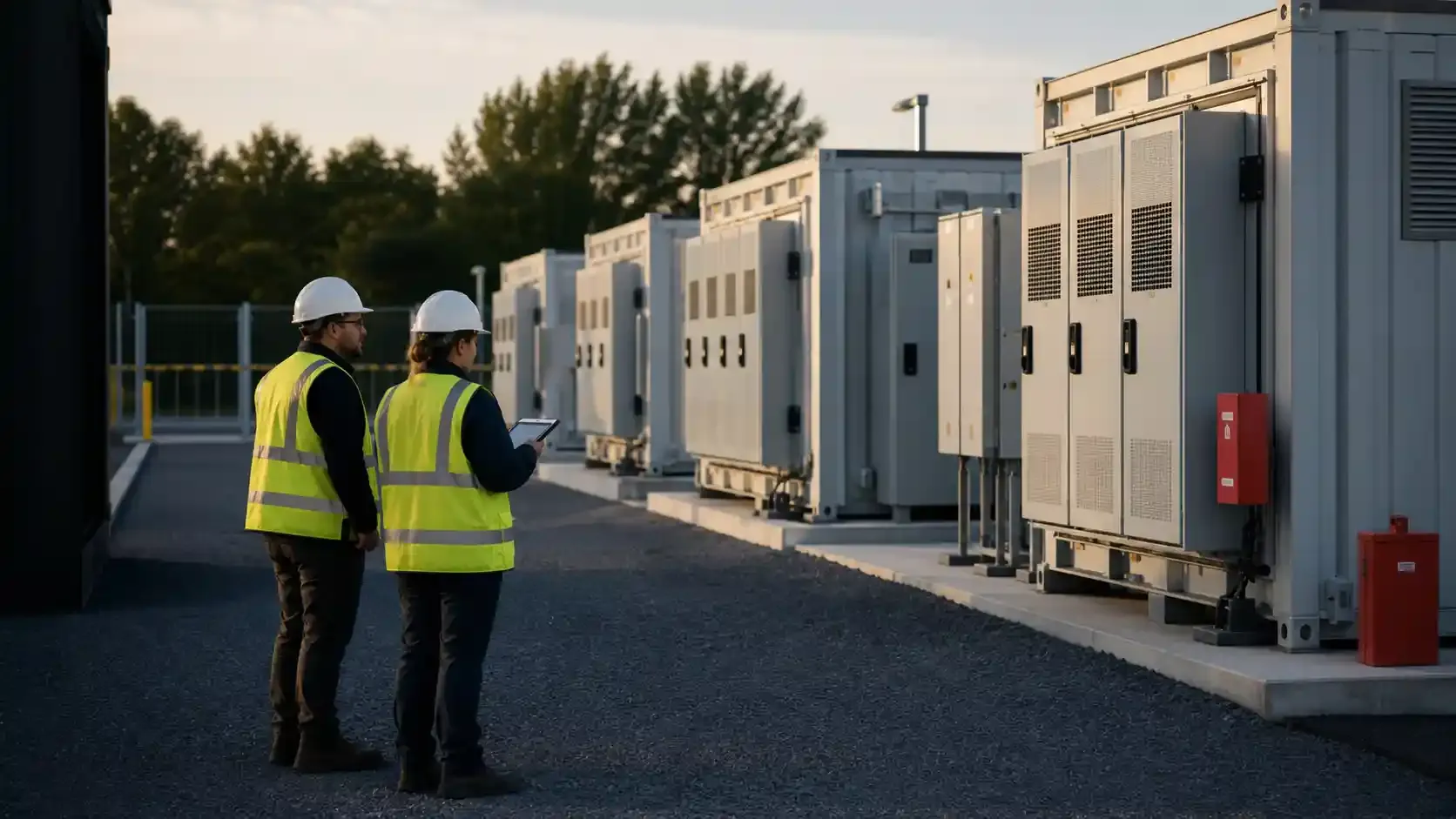
BESS risk is more than a battery fire. Learn how thermal runaway, gas release, fire spread, emergency access and land-use decisions should be assessed together.
Battery Energy Storage Systems: A Process-Safety View of BESS Hazards
Battery energy storage systems are becoming a visible part of commercial and industrial energy projects. They can improve resilience and support renewable generation, but they introduce hazards that need a structured process-safety response. A battery enclosure is not just electrical equipment. It may contain a source of heat, flammable gases, confined-space effects, toxic combustion products and a complex emergency-response challenge.
Start with the credible event sequence
Thermal runaway can begin in one cell or module and develop through heat, gas release and ignition. The key assessment question is not simply “will the battery burn?” It is what happens next.
Review detection, ventilation, enclosure design, spacing, fire spread to neighbouring units, ignition controls, emergency access, runoff, communications and the potential effect on adjacent people or assets. The layout must give responders a workable strategy, not just satisfy an equipment footprint.
Use HAZOP thinking for BESS
Apply the same disciplined questions used in conventional process safety. What if cooling is lost? What if a sensor fails low? What if ventilation does not start? What if a container door is opened after gas has accumulated? What if one unit is isolated but heat affects the next?
A HAZOP or focused hazard review should include the system integrator, electrical engineer, operator, maintainer, fire specialist and emergency-planning lead. It should consider normal operation, commissioning, maintenance, fault recovery and end-of-life handling.
Design multiple, testable barriers
No single device makes a BESS safe. The required barrier set is site-specific but may include suitable cell chemistry and enclosure design, detection, alarm logic, thermal management, ventilation, isolation, spacing, fire suppression or exposure protection, access control and emergency information.
For each barrier, define what is inspected or tested, who owns it and what happens if it is impaired. A detector that is out of calibration, a blocked vent or a failed cooling alarm should be visible in the site’s barrier-health process.
Plan with the emergency services
Responder access, isolation points, battery information, water availability, exclusion zones and communications must be addressed before commissioning. Include fire-service consultation and scenario-based drills. The emergency plan should state what site personnel can safely do, when they must withdraw and how they will communicate the state of charge, equipment configuration and hazards to responders.
Recent South African professional discussion on PV and BESS fire risk reinforces the need for practical mitigation and planning rather than generic assurances.
Consider the surrounding community
Large or closely sited systems may require consequence modelling and a review of off-site effects. Land-use planning for MHI facilities and emergency response compliance provide useful decision frameworks. The actual assessment should reflect the technology, inventory, enclosure, layout and neighbouring receptors.
MMRisk supports BESS developers and operators with early risk reviews, scenario modelling, emergency planning and defensible risk documentation. Contact our team before design freeze or site commissioning.